The common engine powering every Minerva Defence Network simulation service.
The BCI module captures the operator's bioelectric signals in real time, creating a neuro-adaptive feedback loop between the user's cognitive state and the virtual scenario's behaviour. A capability previously available almost exclusively in classified military research laboratories.
| EEG Band | Frequency | Cognitive State | System Response |
|---|---|---|---|
| Delta (δ) | 0.5–4 Hz | Deep fatigue, drowsiness | Session interruption, operator alert |
| Theta (θ) | 4–8 Hz | Focus, working memory | Optimal state confirmation |
| Alpha (α) | 8–13 Hz | Conscious relaxation, baseline | Under-stimulation detection |
| Beta (β) | 13–30 Hz | Active alertness, cognitive stress | Difficulty reduction trigger |
| Gamma (γ) | 30–100 Hz | Sensory integration, flow state | Peak performance maintenance |
| SMR | 12–15 Hz | Fine motor control, stability | Precision-training indicator |
| Composite stress index (β/α + GSR + HRV) | — | Total operational stress | Dynamic scenario adaptation <120ms |
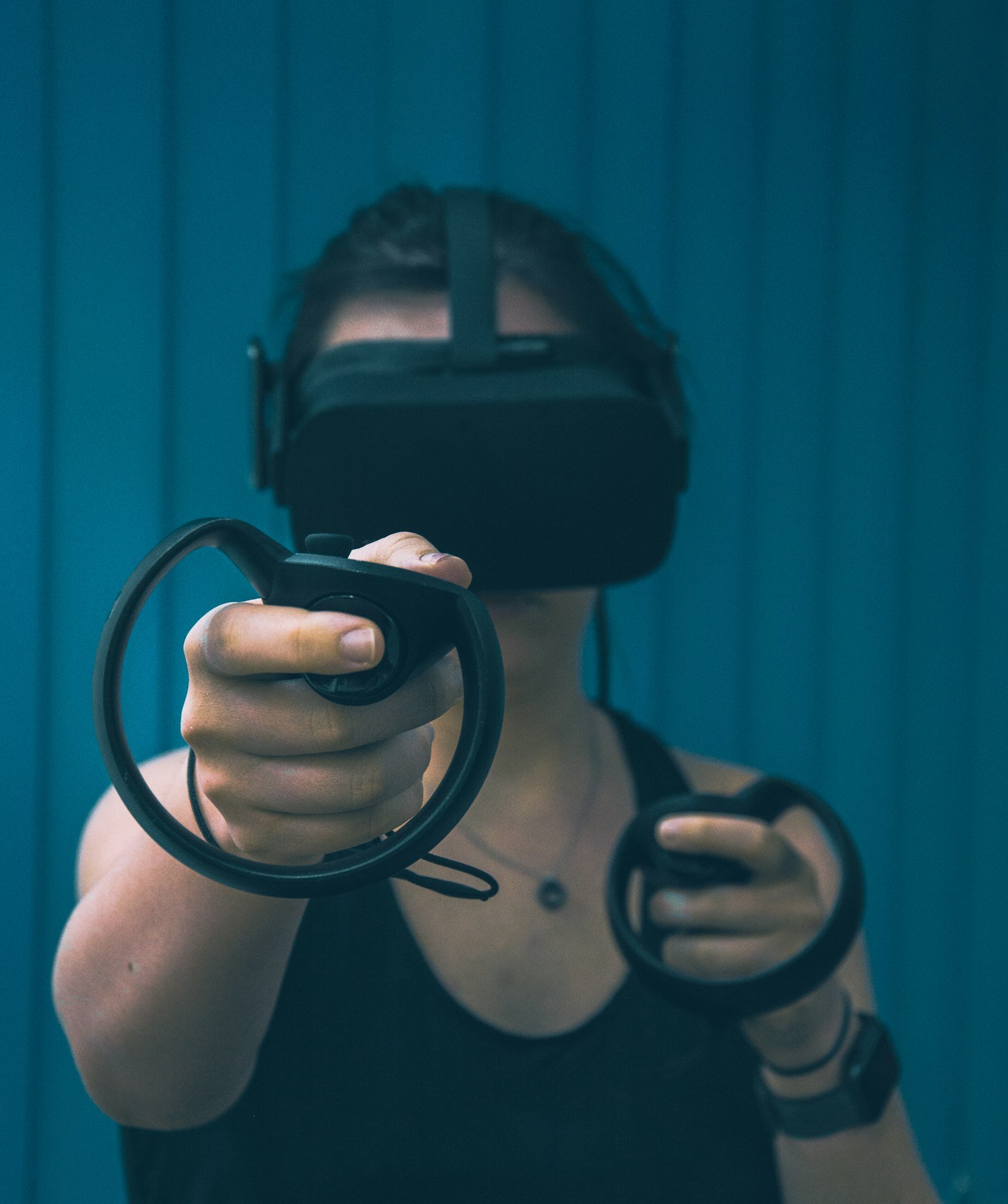
Varjo XR-4 / HTC Vive Pro 2 — ultra-high per-eye resolution, high refresh rate, minimal latency.
Microsoft HoloLens 2 / Magic Leap 2 — wide field of view, 6 degrees-of-freedom tracking.
Bidirectional pneumatic recoil systems with multiple feedback actuators.
bHaptics TactSuit X40 / Teslasuit — multiple impact points, thermal feedback.
360° freedom of movement, anti-fall sensors, harness system.
Sub-millimetre precision, minimal latency, extended surface coverage.
Real-time cognitive state classification through machine learning models.
Kinematic and postural analysis of the operator's movement.
Virtually unlimited procedural generation of new tactical scenarios.
Virtual adversary behaviour, calibrated through reinforcement learning.